The Practical Five: Week 31
Five ideas from AI and product design you can apply by Monday. I read what the builders I follow actually do, not what they predict. Here's what mattered from the last week.

🔬 Research worth using. One finding you can apply, not just nod at.
🤖 AI this week. The signal, not the noise.
🔄 What changed. A product or UX move worth stealing.
📌 Worth remembering. An old idea that explains today.
👀 One more thing. A tool, a take, or something odd I couldn’t drop.
🔬 Research worth using
The “AI is killing indie software” panic doesn’t survive the Stripe numbers.

Greg Isenberg went looking for the collapse everyone’s posting about and found the opposite in Stripe’s data. New companies on Stripe Atlas are up 130% year over year. They’re reaching $10M ARR within three months at double last year’s rate. One in five charges its first customer inside the first month. And the solo founders, the exact people saying they’re getting crushed, are 63% of new companies and pull 2.3x the revenue by month 24 when they’re AI-native.
So who’s actually hurting? One specific group. People selling cheap tools to other indie hackers, with traffic that comes from SEO. Your customers can rebuild your $20 SaaS in a weekend, and the models replaced your traffic source. Two cannons, one little boat.
The move: if that’s your setup, change the customer or change the channel this quarter. If it’s not, you’re building in the best conditions anyone has ever recorded.
“It’s a channel shift wearing a collapse costume.”
🤖 AI this week
One prompt turned Claude into an equity analyst.
Riley Brown pointed Claude’s new Excel extension, running on Opus 5, at NVIDIA. Thirty-seven minutes later he had a five-year DCF model: three years of historicals, a fully linked forecast, working-capital and debt schedules, a WACC sensitivity table, a checks tab, and a one-page dashboard. Sourced only from SEC filings and investor relations. One prompt. 122,000 people watched.
The interesting part isn’t the model. It’s the prompt, and he shared the whole thing. It works because it’s ruthless about rules: name every source, mark missing figures as unavailable, never invent a number, blue for hard-coded inputs and black for formulas.
The move: stop using AI like a faster typist. Write the brief you’d hand a sharp analyst, constraints and all, then give over the entire task. Steal Riley’s structure for any research job you’d normally outsource.
“It researched for 37 minutes and created this in depth analysis on NVIDIA based on all public data.”
🔄 What changed
Marketing agents became the thing to build next.
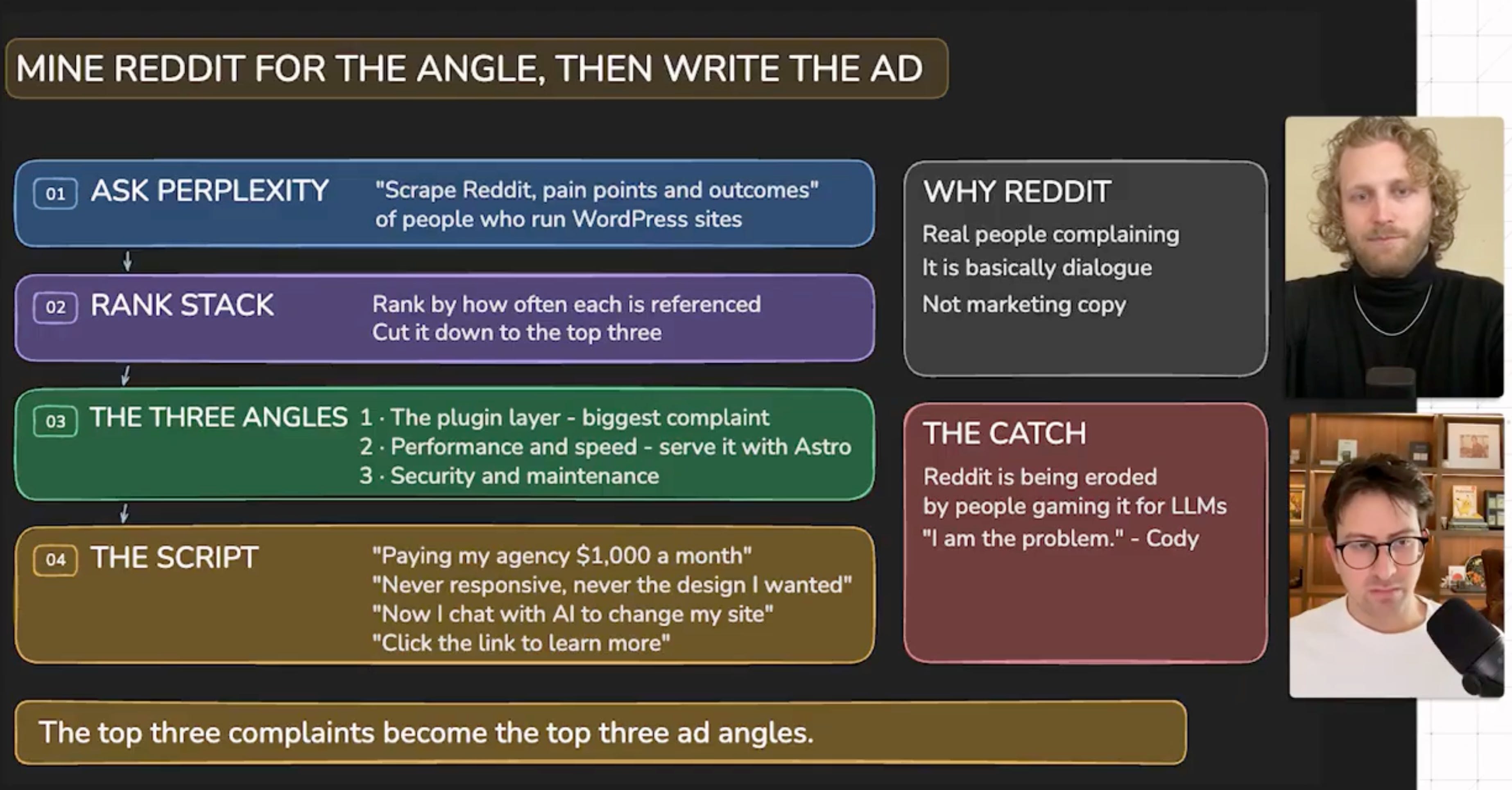
Greg Isenberg (yes, again, he had a week) laid out the full stack for an agent that runs a Facebook ad account on its own. Perplexity scrapes Reddit for the real pain your customers describe. Nano Banana generates on-brand images. A vision model checks them against your brand rules. HeyGen produces the AI video. It’s all wired in a loop that reads the ad performance and reacts, killing the losers and scaling the winners.
Coding agents changed who gets to build. This is the same shift pointed straight at growth.
The move: you don’t need the whole loop this week. Take one piece, Perplexity mining a subreddit for the exact words your customers use about their problem, and drop those words into your next ad or landing-page headline. That alone earns the afternoon.
“Coding agents changed who gets to build software. Marketing agents change who gets to grow a company.”
📌 Worth remembering
The value was never the execution. It was the judgment.

Marc Lou gave Codex one prompt. It built a new iOS app, used his browser to write the App Store listing, uploaded screenshots it took on a simulator, and got the app accepted. He never opened the App Store. His reaction wasn’t a celebration. It was “I’m useless,” followed by the realization that a skill he spent ten years on had just been automated.
Here’s the old idea worth holding onto. When execution gets cheap, taste gets expensive. Deciding what to build, for whom, and knowing when the output is actually good, that’s the part no agent does for you. It’s the same reason a great editor beats a fast writer.
The move: spend less time getting better at the tools and more time getting better at the call. Judgment is the job now.
“The skills I acquired in the last 10 years have become useless.”
👀 One more thing
Your agents are running. So is a tax you’re not counting.
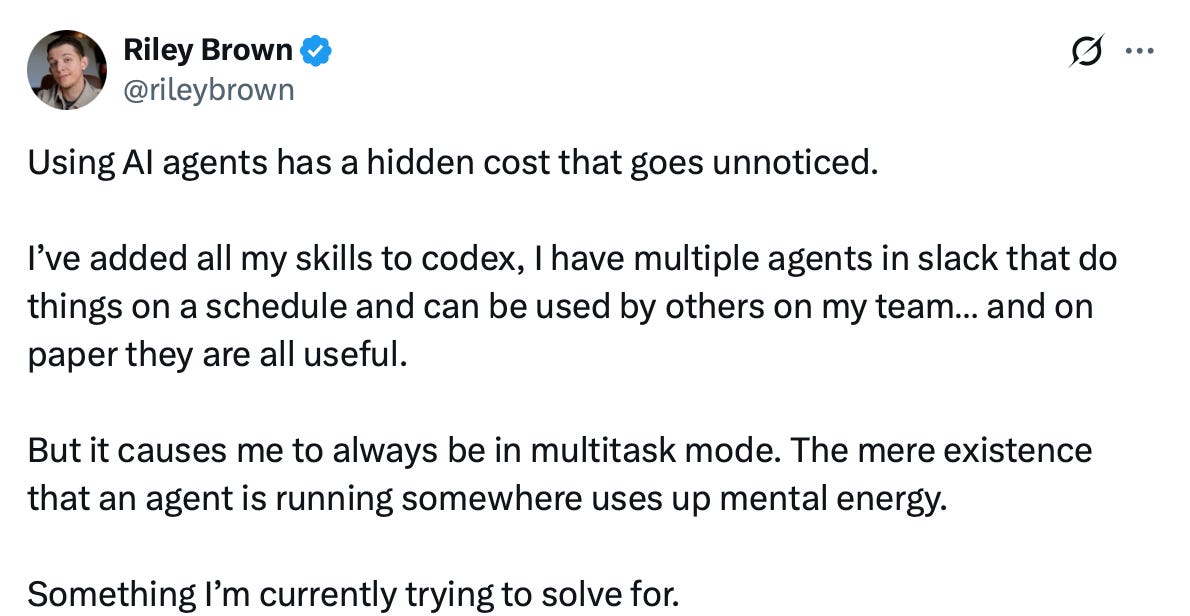
Riley Brown, on the flip side of his own hype, said the quiet part out loud. He’s got agents in Slack on schedules and every skill loaded into Codex, all useful on paper, but “the mere existence that an agent is running somewhere uses up mental energy.” You’re never fully on one thing anymore. Jack Friks went the other direction this week and ran his whole day by voice instead of typing. He found it made him sharper, because you have to think clearly to say a command out loud.
The move: agents put you in permanent multitask mode, and it isn’t free. Turn the notifications off. Run agents in batches instead of always-on. And try giving commands by voice for a day. It forces the clear thinking that half-typed prompts let you skip.
“The mere existence that an agent is running somewhere uses up mental energy.”
Riley’s take · Jack’s experiment
✨ Creator worth a follow

Adham Dannaway. He just shipped namethatui.com, a visual dictionary of UI. Describe the thing in your own sloppy words and get back the real name, the API symbol, and a paste-ready prompt for your coding agent. Exactly the kind of small, sharp tool that saves you ten minutes every time you can’t remember what a component is called.
📡 Built with SnapFast
Full disclosure: I put this whole issue together in about twenty minutes with SnapFast, my tool for following creators across X, YouTube, LinkedIn, and Substack in one clean feed. It’s how I read 150+ posts from the people above without living inside the algorithm. If you want your own practical five every week without the doomscroll, that’s what it’s for. snapfast.ai